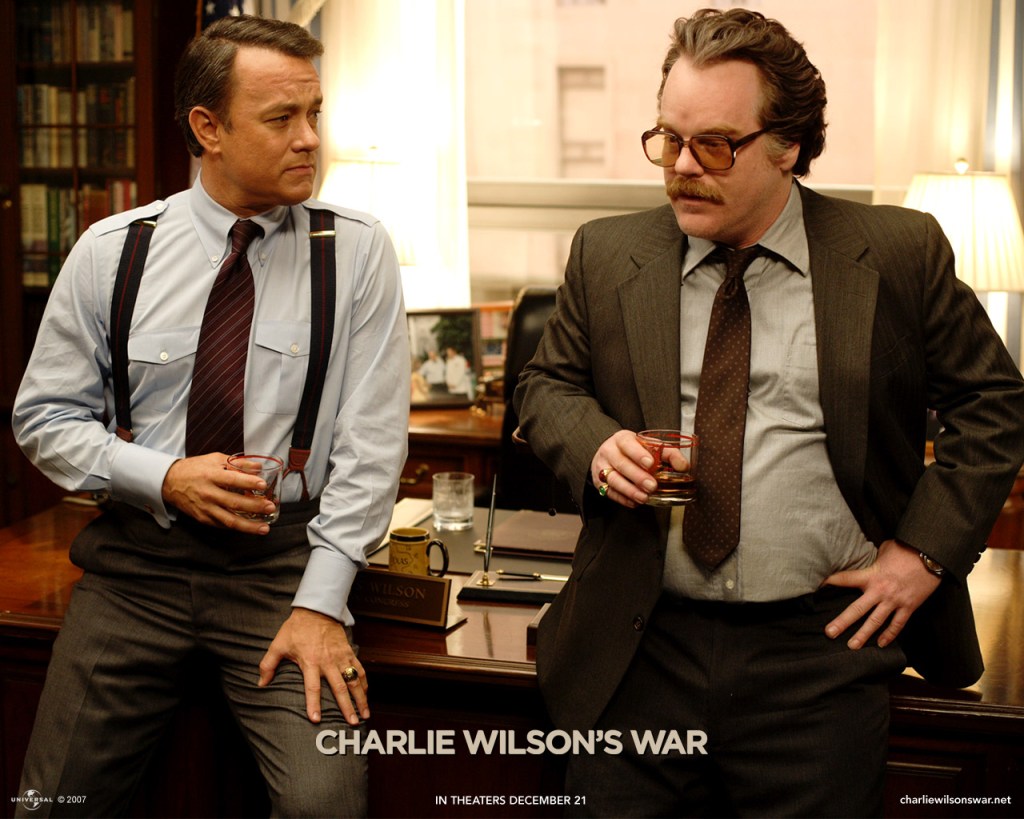
Charlie Wilson’s War is not quite a bullseye but second tier Aaron Sorkin is still full of crackle and wit.
Sorkin is a screenwriter, like David Mamet, Quentin Tarantino, Jane Espensen and Kevin Smith who’s style is so distinct that I can pick it out with my eyes closed.
Most of us who write are interchangeable but a few have a style so distinct that it is unmissable.
And this is right in what would seem to be Sorkin’s wheelhouse. A somewhat true history about a shady US Congressman who recognized that the country should fund Afghanistan fighters in their war for freedom against Russia.
Sorkin, who wrote both the American President and the untouchable first four years of The West Wing is the perfect guy for a tale about the inner workings of the US Government.
The movie joins Wilson at a party with naked playboy models and cocaine in Las Vegas. Wilson clearly revels in a liberated life and is enjoying the perks all his status has to offer.
Here’s his statement to the press when a scandal about that lifestyle breaks, “The congressman has never been to rehab. They don’t serve whiskey in rehab.”
Whether or not Charlie Wilson needs to go to rehab (yes he does) is not the point. Wilson (Tom Hanks) is functioning just fine and he seems to be able to do a decent job of being a congressman.
He offers an obvious solution to a political problem early in the flick and surrounds himself with a whipsmart staff. They also happen to all be beautiful women.
He has a reason for that … which I’m not going to repeat here.
Wilson gets dragged into the Afghanistan conflict and then he goes to the country and finds himself in a unique place where he has the power to do, what he believes is an important thing.
He will use the levers of the US government to fund the Mujahideen and fight off the Russians. Afghanistan will become their Vietnam — a quagmire that drags the whole empire down.
Wilson is joined by Julia Roberts who is having a ball playing the 8th richest woman in Texas and who sees Afghanistan as a holy war for her particular flavor of conservative Christianity.
And the late Philip Seymore Hoffman plays CIA Agent Gust Avrakotos who is perhaps the only spy in the history of the movies who constantly tells the truth to everyone he meets.
I particularly enjoy the way Hoffman hits this line, “For twenty-four years people have been trying to kill me. People who know how.”
The movie has a solid flow and it rushes through its historical set up and then to what Wilson and his compradres did to fund this phase of the cold war with the Russians without starting a hot war.
I think the rush to the finish line sacrificed a lot of nuance and I get the feeling that some scenes were left on the cutting room floor. There are times when Wilson seems to have serious alcohol related medical issues but that’s never dealt with or explained.
And this ever rises to top-tier Sorkin for me. It’s not in the same league as Moneyball or The Social Network. I’m not sure I can articulate exactly why. I wonder if it’s just hard to buy Tom Hanks as a congressman who says with a straight face:
Charlie Wilson: Well, Jesus, Donnelly. Everyone in town knows I’m on the other side of that issue.
Donnelly: Ethics?
Charlie Wilson: Yeah!
Hanks’ persona is built on earnest affability. But Charlie Wilson needed something different, I think. Hanks doesn’t, for instance, snort cocaine at a cocaine party in Vegas. Later, Hanks would say that he didn’t refuse to do it but that no one ever asked him to pretend to do a line.
That’s kind of the definition of the problem. Would casting someone else have made a difference?
Maybe. We’ll never really know. To quote a former U.S. Secretary of Defense it’s an unknown unknown.
In the end Charlie Wilson is around to catch both his flowers and a warning from Gust about how this glorious victory might backfire.
The audience and the filmmakers have the benefit of hindsight and so we know that eventually, the Mujahideen come to believe that Russia is only one of their enemies and that they attack us several times over the next few decades until they kill 3,000 Americans on 9/11.
The movie suggests that if America had done more to rebuild Afghanistan after Russia fled this might not have happened.
Perhaps.
Or perhaps the people who attacked America were simply mad men who would attack us no matter what we did or didn’t do.
I’m reminded of a quote from another great war movie.
“Doesn’t matter what it was. When one man says to another, “I know what let’s do today, let’s play the war game.”… everybody dies.”
A Bridge Too Far
 Dark Highways
Leave a comment