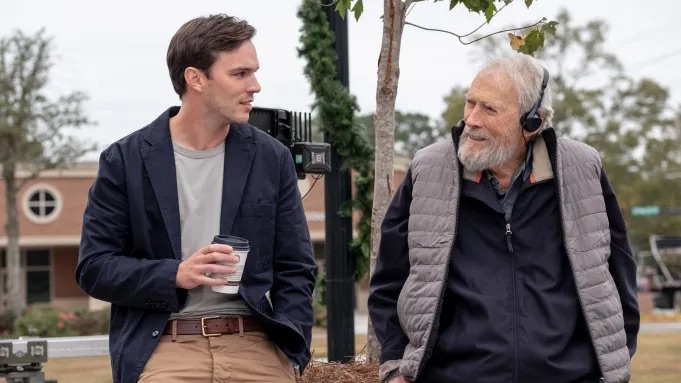
In his final years Clint Eastwood directs movies the way Ernest Hemingway wrote novels — straight, true and unadorned.
There is nothing in Juror #2 that anyone might mistake for a director showing off. Maybe J.K.Simmons’ hat.
Nor is there anything in the writing that gilds the lily. The ‘just the facts’ and ‘just what we need per scene’ could be mistaken for boring. And, given what a fan I am of more showy writing I can tell you that this style does test my patience.
But there are very few movies I watched this year that set a deep pit in my gut and did not let go. And great writing is sometimes a lot more or a lot less than great dialogue.
If you have seen the trailer you know Nicholous Hoult’s Justin Kemp is called for jury duty for a murder and discovers that he accidentally killed a woman in a car accident. Now, with an innocent man’s life on the line he faces a moral crisis about whether to come forward, stop the trial and confess.
The movie does a nice job of giving you a bit of everything from an update on 12 Angry Men to a normal courtroom drama and some realistic investigative work.
As a reporter I spent years hanging out with homicide detectives and covering trials and a lot of the time I can’t sit through these kinds of stories.
If you know how it actually works you find that nearly every murder mystery movie, detective show or lawyer novel is not just unrealistic, it’s pure fantasy. What happens in Mordor is more true to life than what happens in the fictional jury box.
But this one — despite a few left turns — rings true.
What the movie is concerned with, mostly, is an ethical test. It sets the challenge to Hoult’s Kemp and then watches what he does.
The story does everything it can to present Kemp as a sympathetic and decent man who, if he had known what he had done when it happened would almost assuredly have reacted the right way. But the movie makes it clear that Kemp is now faced with an almost certain condemnation and a prison sentence because of past mistakes. So he looks for a way to save himself and — if he can — save the innocent man on trial.
Eastwood and writer Jonathan Abrams fill the flick with little moments that show where Kemp’s priorities lie as he comes to a final test. At one point he ducks in the jury box so a witness won’t recognize him. At another he stymies a juror who is getting too close to the truth.
Rescue the innocent man? Sure, Kemp says to himself, as he convinces half the jury that they should acquit. But only if he can keep his own head out of the noose.
Despite these incidents the movie reserves judgement until its final shot.
I don’t want to give it away.
But we find that just like Kemp another character in this story was facing a critical moral test.
In the end, only one of them comes out upright and righteous.
 Dark Highways
Leave a comment