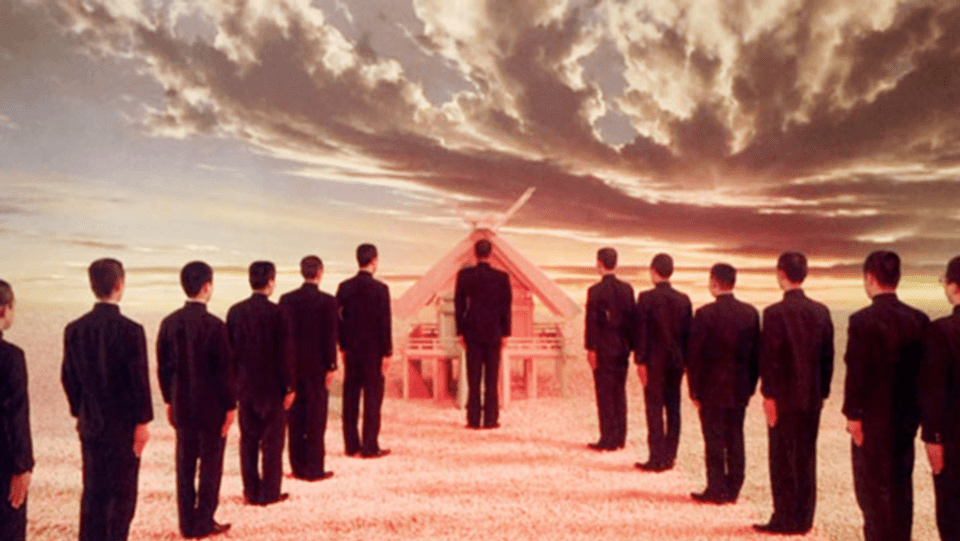
There is a deep temptation here, to deal with this movie in a review, to make a joke.
This is how Americans in my generation deal with this level of sincerity. After all this is a movie about a guy who was so committed to his beliefs that he killed himself over them.
As I consider my joke I’m thinking of screenwriter William Goldman who wrote that he regretted the ending of Butch Cassidy and the Sundance Kid.
The movie famously has one of the greatest endings in cinema as Butch and Sundance face down the entire Bolivian Army and go out to certain death with their guns firing and with their cowboy boots still on.
Thats’s the western version of the samurai decision to commit seppuko. In the movies American men kill themselves for their beliefs too but they always take some evil bastards with them.
So what was Goldman’s problem with the ending he wrote that everyone else thought was perfect? There were too many lines between Butch and Sundance in their final moments, too many quips. He wrote in Adventures in the Screen Trade that he wished he had just let them go out without all the verbal turns.
That is not a problem the writer and director Paul Schrader has ever encountered. If you told me Schrader had ever heard a joke, much less laughed at one, I’m not sure I would believe you.
Mishima is both deeply outside of Schraders normal fare and also well within his normal themes.
The true story of one of Japan’s most famous writers who is deeply committed to a set of beliefs about Japanese society and ultimately determines that he must follow those beliefs into death.
Schrader and his brother Leonard and Leonard’s wife Chieko wrote the screenplay. It infuses Mishima’s stories and philosophy into the movie while also giving us glimpse of elements that Mishima probably didn’t want us to see. It’s visually inventive and it has a unique (for Schrader) story structure.
Schrader wrote Taxi Driver (1976), wrote and directed American Gigolo (1980), Light Sleeper (1992). Taken together they’re the God’s Loneliest Man trilogy. I previously joked that he invented the male loneliness epidemic. Schrader’s next trilogy Man in a Room consisted of First Reformed (2017), The Card Counter (2021) and Master Gardner (2023).
I think they’re all fantastic but they should also come with warning labels. Schrader movies are an acquired taste that delve deeply into depression and suicide. I think as a writer he only considered redemption for any of his protagonists recently.
I need to watch Mishima a couple of more times to really take it all in. I got lost a few times as the movie weaves between real life and Mishima’s stories and what was happening in the final sequence. Elements of that final section are sprinkled throughout the movie. Some of my issue was just the chaos of watching it at home and getting pulled away from time to time.
But some of it is that the material is dense and meant to be closely examined. It’s like that sometimes when you deal with a masterpiece.
Anyway, here’s my little joke.
Two samurai watch as a third commit seppuku. As he screams and blood splatters and dies the first samurai leans over to the second.
“What was his problem?” he asks.
“Yeah,” the second one replies. “He was too committed to the bit.”
 Dark Highways
Leave a comment