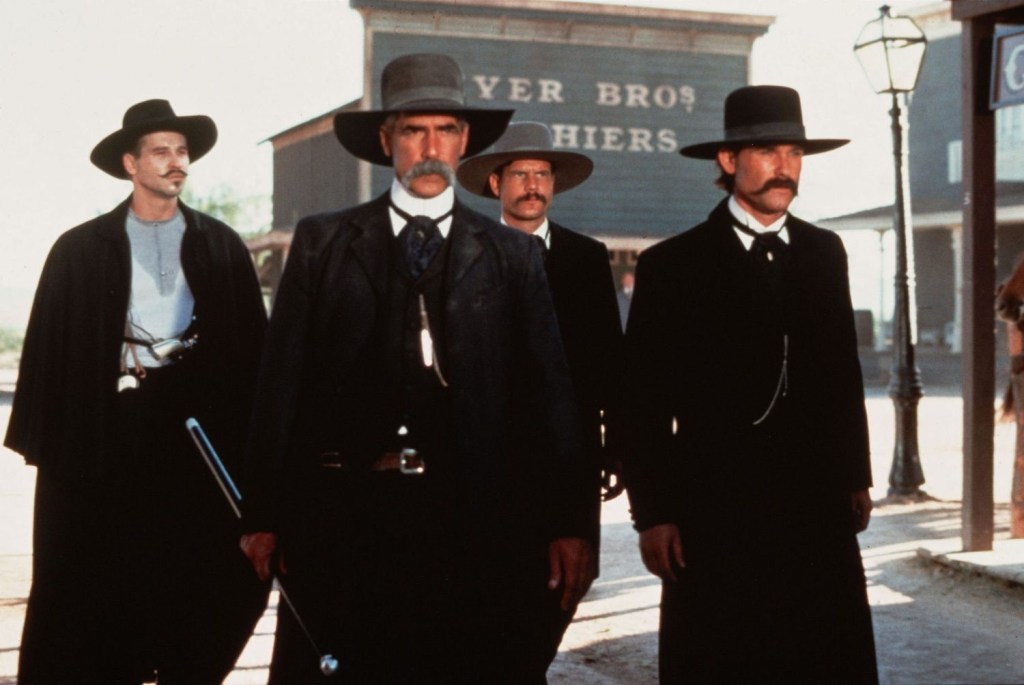
Explaining the Righteous Mexican Standoff
You know what scene always works in movies? The Righteous Mexican Standoff.
Please do not confuse this with the traditional Mexican Standoff. In the traditional Mexican Standoff, all the participants are on equal footing.
We are definitely meant to root for Clint Eastwood in the final standoff in The Good the Bad, and the Ugly. But it is still a traditional Mexican Standoff because of how it is shown, shot, and how it plays out.
In the traditional form, we are either supposed to sympathize with both parties, even if one is a gangster and the other is a cop (The Killer), or we are supposed to sympathize with none of the parties, like in True Romance. In True Romance, the cops, mobsters, and Hollywood security guys find themselves staring each other down, but our hero (Clarence) isn’t part of the standoff; he’s just trying to navigate a way out the door through a hail of bullets.
But in the Righteous Mexican Standoff, we go completely with the good guy, and it usually ends without a bullet being fired.
Tombstone, Wyatt Earp, Deadwood, and a host of other (mostly westerns) give us the template for the RMS. The town, made up of either vengeance seekers or straight-up bad guys surround the law officer and demands that he give up a prisoner.
Instead, he pulls out his weapon, aims it at the mouthiest of the bad guy group, and says, “That’s not going to happen unless you kill me. And while you guys outnumber me, I’m going to get as many of you as possible on the way to the pearly gates. … Starting with you, mouthy asshole number 1.”
And so on. The bad guys then, seeing that the law officer is serious and possibly insane, back down.
Is this a thing that can actually happen in real life? I would say probably not. What’s to stop someone in the back of the group from letting one fly and seeing how things work out?
But my mind is wandering in this general direction because I watched Wyatt Earp and then Tombstone back to back, and how they handled a similar scene is indicative of the successes and failures of those movies as a whole.
If you were going to say, write a review that pitted both movies against each other this would be a good place to start.
Ahem.
The Standoff
The Righteous Mexican Standoff in Wyatt Earp is the last scene in the movie. Wyatt and his wife, Josephine, are on a boat headed to pan for gold in Alaska when a young man approaches him and reminds him of a time, in his salad days, when Earp saved his uncle’s life.
The scene is meant to show a couple of things:
1) That Earp has become a legend within his own lifetime.
2) That fame hasn’t brought him any material success.
3) That even now, he is still wrestling with the decisions he made and the life he lived.
It’s not a celebration of violence, or manhood, or of “taming the west,” but another broody, melancholic moment in a movie filled with melancholy.
Earp learns that the criminal he saved died a few years later in some other criminal scheme. And as the young man leaves Wyatt turns to Josephine and says, “Some people say it didn’t happen that way.”
She replies, “Don’t listen to them. It happened that way.”
Is this an accurate representation of Wyatt Earp and how he felt about his life? I dunno. But what I will tell you is that even though I enjoy Wyatt Earp (the movie), I also know why it was a box office bomb. Ain’t nobody standing in the aisles cheering at that ending.
Here’s how Tombstone handles the standoff.
First off all, Tombstone loves these stand-offs and does them to one extent or another three or four times in a two-hour movie. What is that back and forth between Johnny Ringo’s pistols and Doc Holliday’s little coffee cup if not an amusing standoff between deadly men?
But the first official RMS is between Kurt Russell’s Wyatt Earp and Billy Bob Thornton’s Johnny Tyler. And before we get too far into it, we must give credit to Tombstone’s casting director, Lora Kennedy, because every role in this thing is played perfectly. I can’t tell you most of the main cast in Wyatt Earp, but I can tell you the names and character moments of almost everyone in Tombstone, including people who only got one or two lines.
Anyway, Johnny Tyler is a loud bully. Earp sizes him up, walks over to him at a card table, berates him, dares him to pull a gun, and smacks him around until the confrontation is mostly over.
Later, Tyler grabs a shotgun and heads into the street (presumably to kill Earp) when he sees Doc Holliday, gets spooked, and is told to leave the shotgun and, embarrassed and humbled, gives up and walks away.
You know what this is? This is a ton of fun.
As the kids might say, Wyatt has so much aura that people just drop their guns, even though they’ve got him at point-blank range, because they know they’ll be killed by a legend.
Is that true? Is that even possible? Who cares? It’s wonderful cinema.
There’s a lot of “who cares cause this looks or sounds awesome” in Tombstone. And precious little of it in Wyatt Earp.
For instance, a house is on fire behind them when the Earps walk down the street to the OK Corral. Why? Cause it looks cool. Also in that scene, Earp’s future wife is dressed either like the devil or death for some sort of photo. Why? Cause it looks cool.
There is a dang montage of good guys killing bad guys at the end of the film. It’s ridiculous. But it’s also dope.
It’s a movie filled with scenes and asides that make little sense but are so wonderful that you never stop to consider whether any of it could possibly happen in the real world. Who the heck wants to live in the real world anyway?
The second Righteous Mexican Standoff in Tombstone happens when Wyatt takes Curly Bill Brocius into custody after Brocious kills Marshall Fred White in the street. Wyatt is confronted by some townspeople who want to hang Brocious and by Ike Clanton and the Clanton gang, who want to free him.
Wyatt freezes this situation by placing his gun directly between Clanton’s eyes.
“You die first, get it? Your friends might get me in a rush, but not before I make your head into a canoe, you understand me?”
You have to see the look on Clanton’s face (played by Stephen Lang!) to really get this next part, but it is hilarious. One of the others states that Wyatt’s bluffing.
“No. He ain’t bluffin’,” Ike Clanton says, trembling.
“You’re not as stupid as you look, Ike,” Wyatt replies.
And that’s it. Murderous lynch mob called off on account of one crazy person with a gun.
Again, there’s nothing at all like this in Wyatt Earp. He mostly knocks out people from behind before things get out of hand. And that is, I suspect, as true to the real-life Wyatt Earp as possible. Earp didn’t survive the Old West by daring people to draw their guns and relying on his personal magnetism to block the bullets. He survived by efficiently turning the lights out on anyone who might have a weapon who dared look at him crossways or with ill intent.
In fact, there is a whole section of Wyatt Earp that explains that everything the heroes of Tombstone do is wrong and stupid.
‘He’s Affable’
Wyatt Earp takes the time to show us how Wyatt Earp met Bat and Ed Masterson first as buffalo hunters, and then he takes them under his wing as lawmen.
Wyatt lets Bat and Ed disarm some men, and when Ed talks too long, Wyatt knocks out the men. Ed protests, claiming that he was about to talk them down, and Wyatt points out that one of them had a small gun concealed and ready to use. He tells Bat that he has the right instincts for the work and urges Ed to go into something else.
“Politics, maybe.”
Why? Cause if he stays in law enforcement, he’s going to get himself and the people around him killed.
“You’re not a deliberate man, Ed,” Wyatt says. “I don’t sense that about you. You’re too affable.”
Wyatt Earp is such a deliberate movie that affability comes up exactly two more times, fulfilling the rule of three.
The second is during a conversation after Wyatt has lost his job and the city has given it to Ed Masterson instead because Wyatt is unpopular (some of the townfolk are surely tired of getting hit on the head every time they get out of line.)
A bartender casually asks Wyatt how his life is going, and he explains that he doesn’t have his job anymore and that Ed took over.
“What’s he like?”
“He’s affable,” Wyatt replies.
The word affable is not directly stated in the third reference. But we do see Ed Masterson being quite the affable guy and talking to some drunks in his people-pleasing way right up until he is shot and killed.
This scene is one of the best examples of what Wyatt Earp is trying to accomplish. Essentially, everyone is getting together to try and win Kevin Costner another Oscar.
Well, no, not exactly, but every scene is dedicated to trying to explain the actions and decision of the real life, historical Wyatt Earp.
So why does Wyatt try to keep his brothers together for so long? Because his daddy, Gene Hackman, told him that nothing counts so much as blood. Why is he cold to his second wife? Cause his first wife died on him while she was pregnant, and he can’t let himself love someone like that again.
It’s a movie that concerns itself with even the details of Wyatt’s choice in beverages. After his first wife died, Wyatt became a drunk and nearly got himself killed. After his dad gets him right again, he is always noticeably drinking coffee.
Tombstone is a fantasy action film with a revenge plot at the end. Wyatt Earp is a serious-minded account of a real historical figure.
Unfortunately, Wyatt Earp as a person is too taciturn to entertain a movie audience. He isn’t really a joy to be around in Tombstone either — although he is a bit more affable.
But Tombstone lets us get to know everyone. Here, you can enjoy Doc Holliday’s delicious threats, Sam Elliot’s (Virgil Earp) cowboy earnestness, and Dana Delany’s romantic struggles.
Also, Powers Boothe, Michael Beihn, and Stephen Lang become the living embodiment of smug evil, insane evil, and cowardly evil.
Powers Boothe is so good at being evil; he can portray it just by sticking his tongue out at some point in every scene. You want to shoot him the moment you see him and before he ever says a word. That little laugh of his is wicked too; it makes you wish you could remove his teeth with your fists.
A Reckoning
You could make an argument that the reason Tombstone became the winner in this round of Hollywood doubles is because of Val Kilmer. It isn’t just that he has the best lines and that Kurt Russell was generous enough to let Kilmer run with the ball. That’s part of it for sure.
Anyone can make a scene like this work:
One guy says you can’t shoot me, you are so drunk you’re probably seeing double, and the other guy replies, “I have two guns, one for each of you.”
But that Val Kilmer’s dry southern delivery works in every moment. On the page, nothing about Doc’s confrontation with a man who accuses him of cheating jumps out at you.
But on the screen …
“Why, Ed, does this mean we’re not friends anymore? You know, Ed, if I thought you weren’t my friend… I just don’t think I could bear it.”
If you have seen the movie, I guarantee you read that line in Kilmer’s remarkable Doc Holliday voice. Such is the power of his performance.
At one point, Wyatt walks into a hail of bullets and does a miraculous bit of gun slinging after he is ambushed by a group of killers. No bullet can touch him, and meanwhile, he kills every villain nearby.
Later, someone asks Doc Holiday where Wyatt has gone.
“Down by the creek, walking on water.”
But Tombstone doesn’t stop at Doc because every character is fully drawn. From the two characters (Jason Priestley’s Billy Breckinridge and Billy Zane’s Mr. Fabian) who are having a relationship (off-screen … it was the 1990s) to Michael Rooker’s Sherman McMasters, whose face in his first scenf suggests that his ultimate fate will be to abandon his life of crime and follow the straight and narrow.
Everyone in Tombstone has an inner life, and they are following their own individual stories. We don’t see more than glimpses of them, but those glimpses help turn the whole movie into something more than shoot-em-up.
On the other hand, there is nothing in Tombstone quite so cinematic or symbolic as Kevin Costner’s young Wyatt Earp holding a gun up to the sky for the first time while a hail of fireworks goes off behind him.
Wyatt Earp is a movie that feels like it should play in a theater from a time when everyone got dressed up to go to the cinema. Tombstone feels like the first half of a drive-in double feature. The best drive-in double feature you might ever be lucky enough to see, but my point stands.
As I reckon with both movies, I can tell you that Tombstone stands strong and would probably win in any reasoned debate on the merits.
But I still hold a place for Wyatt Earp. For I am a man in middle age and I understand what it is like to look back with melancholy at all your decisions and wonder which of them were right and if any of them doomed your soul.
 Dark Highways
Leave a comment