“You’re not a bad person. You’re a terrific person. You’re my favorite person,” — Bill
Chapter 1: The Intro
When people ask me if I went to film school I tell them, ‘no, I went to films.’ — QT
Deep breath … focus … center your Chi … Ready? Let’s do it.
In all the ways a movie can be a masterpiece Kill Bill formerly split up into Parts 1 and 2 and now joined back together and dubbed The Whole Bloody Affair is a masterpiece.
And if I were some other man, and this were some other movie I could stop right there. There’s no need to get chatty. Except that like Writer/Director Quentin Tarantino I have a lot I want to say and when you have something to say it is better to say that thing than it is to keep the thing you have to say unsaid.
Costumes, set design, action choreography, story, dialogue, cinematography casting, acting, direction, score and song selection are most of the things we must have to make a movie. In Kill Bill each of them is perfect.
I’d have to go back and look at the contenders but I’m certain that each volume would have been my top movie of the year in the years they were released. Re-cut and re-released together in 2025 it may be my favorite film of this year as well.
So, if you decide to keep going with this review at least you know who you are dealing with.
Chapter 5: My Bloody Backstory
My movies are painfully personal, but I’m never trying to let you know how personal they are. It’s my job to make it be personal, and also to disguise that so only I or the people who know me know how personal it is. ‘Kill Bill’ is a very personal movie. — QT
Tarantino has been part of my cinema experience for my whole life. You know how you have a favorite band in high school (Guns n Roses for me) and they are your favorite band for the rest of your life?
That’s me on Tarantino honey bunny.
Reservoir Dogs came out when I was in middle school. I did not see it in theaters. Pulp Fiction came out when I was in high school and it was a sensation. Everyone saw it. And then we heard about Reservoir Dogs and went back and watched it.
I had a card to Blockbuster and Movie Gallery so I could generally find anything (I thought).
Jackie Brown was next and I liked it but didn’t get it initially. It took four or five rewatches to love it. But I eventually loved it and not only loved it but understood why Tarantino felt he had to make that movie after the unique experience of making something like Pulp Fiction being outrageously honored for it and then feeling what I can only imagine is enormous, unthinkable pressure to make a follow up.
It is a great movie and it is decidedly and purposefully not a sequel or a remake of Pulp Fiction.
In all these years Tarantino’s unique personality was certainly part of the package. I didn’t not come here to defend whatever he’s said or done lately that has upset a bunch of randos on the Internet. I spend a lot of time with the work. I spend a lot of time watching movies. I spend almost no time concerning myself with the politics or opinions of people I am never going to be around in the rest of my life.
You may feel different. When you hear about some awful or evil thing someone has done that may be your limit. I certainly have my own.
But as Neil Young once said, “they do their thing, I’ll do mine.”
Also, children, life was different back then. For one, there was an infant web and no social media. Everyone in the whole world was not constantly shouting their opinions at you. And if a director said something ridiculous it almost never became a big deal.
Go watch interviews with Tarantino in this time period. He hasn’t changed. I distinctly remember him slagging some master director or another on Charlie Rose. He was always this obnoxious.
It’s just that most of the world ignored it, or couldn’t profit by being mad it, and the rest of us thought it was fun to hear non diplomatic answers (for once) from a great director.
And for all of Tarantino’s bluster and ego and penchant for saying ridiculous things there is one constant about him: He’s the greatest director of his generation.
Or as we say down south, “It ain’t bragging if you can back it up.”
Chapter 3: The Second Half of Kill Bill
I come from a mixed family, where my mother is art house cinema and my father is B-movie genre cinema. They’re estranged, and I’ve been trying to bring them together for all of my career to one degree or another. — QT
Having taken us to the Promised Land and the apex of his movie with the Blue Leaves sequence the second half of Kill Bill sets a more leisurely pace.
When it was initially released there were those (idiots mostly) who claimed Part 2 was a let down.
But the whole movie can’t just be The House of Blue Leaves over and over again. Hollywood would eventually do just that sort of thing with the ever diminishing sequels and spinoffs of various franchises.
Oh you liked this? Here is a lot more of this.
Instead, the second half of Kill Bill follows it’s revenge plot and genre exercises down several distinct paths. So we get a Western, a horror film (“so that’s a Texas funeral”), a kung fu training sequence, a kung fu boss battle, one scene that suggests an adult oriented exploitation film, and then a final confrontation.
Meanwhile, this part of the movie explicitly shows us something that the first half only hinted at. The Bride is not just killing a group of nameless, faceless enemies who did her a bad turn. She is systematically murdering the people who were the closest to her in her life.
Bill was her first true love. Oren was like a sister. Budd was Bill’s brother and was always around. Vernita was a co-worker and not much more. And Elle was her work rival for jobs and (you would suspect) Bill’s affection.
When they talk about one another (which I grant you they do a lot) it’s with love and admiration. Budd agrees that she should have her revenge but he loves his brother (even if he’d never say it) so when he tells The Bride he’s killing her because she broke Bill’s heart it hits just as hard as the nails in her coffin.
Even Elle, who hates everything and everyone, talks about The Bride with a grudging respect that borders on as close to friendship as Elle could ever get with anyone.
The Bride trusted all of these people with her very life. She had to. Could some of them betray her? Sure, Elle almost certainly and Vernita. Budd too, if the price was right. But Oren? That one clearly hurt. And Bill? Well, as she tells him herself. The thought of Bill betraying her would have been at the top of her list of things that would never happen. Her list of impossible things.
And yet, it did happen. And now they all must die.
It’s a ridiculous story but my God is it satisfying and magical to watch.
Addendum: The Whole Bloody Affair eliminates the only scene in the two part movie that I don’t like. The one that opens the second movie with The Bride summing up the first movie. She’s driving and talking to the camera about how she roared, and rampaged and now she will get bloody satisfaction and Kill Bill.
It was always stuck out like a sore thumb to me. And now it’s gone. And the world is better for it.
Chapter 2: The Apex
“Violence is one of the most fun things to watch.” — QT
When Tarantino showed Kill Bill to his producers (let’s ignore which ones in particular because I don’t want to get into that real life horrific backstory) they urged him to cut it into two movies.
The first part would end at The Showdown at the House of Blue Leaves. And then Tarantino would get a year to tinker with the second part.
Ultimately, Tarantino agreed and made some necessary changes.
He also switched part of the bloody Blue Leaves sequence into black and white. Essentially, this was forced on him by the MPAA which threatened the movie with an NC-17 rating. In America that would have meant death at the box office.
The Whole Bloody Affair gives us that sequence in color, adds a long animation section as part of Oren’s backstory (it’s a section between what was already there) and an intermission where the original release ended at Volume 1.
For a lot of reasons this seems like a superior experience. First, because this is Tarantino’s take on the big third movie in historic trilogies. It’s his The Good, The Bad and The Ugly.
It’s an epic that is meant to be an epic. I can hear your kidneys growling. A four hour run time. To which I can only paraphrase Roger Ebert: a terrible movie is never short enough and a great movie can never be too long.
It didn’t feel long to me but I adore every sequence in the film. You can say a lot of things about Kill Bill but you can’t say it’s dull. It’s amazing at every turn.
Finally part of one four hour movie Blue Leaves becomes what I think it was meant to be — the Apex of the movie. Each sequence following it is meant to ease us down from that extraordinary high.
It is an amazing section that is part of an amazing film.
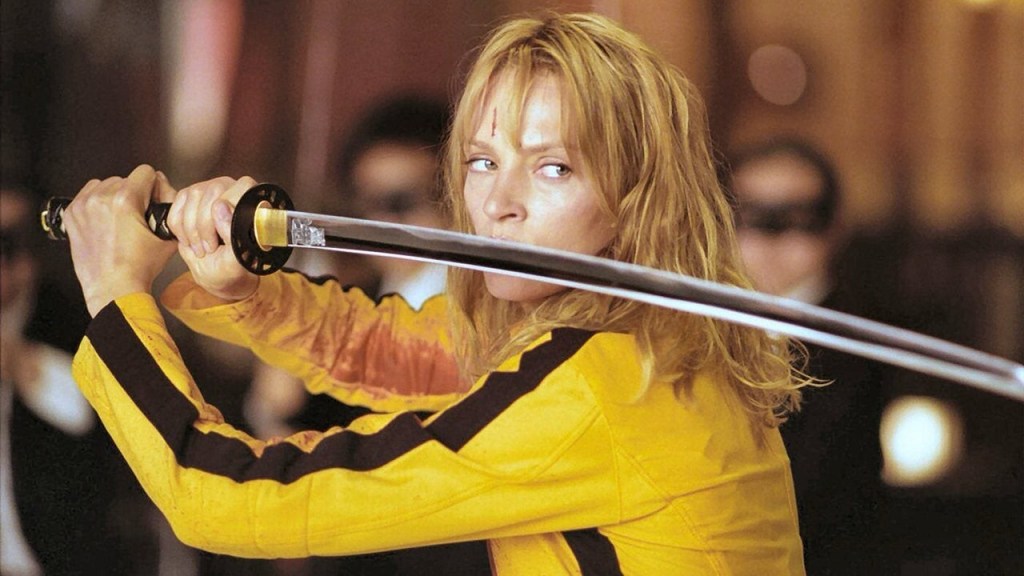
Do you know when you know than you are about to watch something special? You might guess it’s when the Bride is stalking them while wearing Bruce Lee’s jumpsuit and riding a motorcycle.
But no, it’s earlier than that. It’s when she’s on that fake looking plane and she is flying under a red glow to Japan. If you haven’t noticed it before check out how she is carrying her katana on the plane with her.
It’s a helluva funny joke and a line in the sand. This world is not the world you are familiar with. Our characters are part of an insane universe where people just carry instruments of death through security and on a plane.
In this moment Tarantino cranks it up to 11. Get ready, keep your arms inside the ride and make peace with your chosen diety The Bride is coming and bloody vengeance and hell is riding with her.
Chapter 4: Music and Hijinks
I’ve always thought my soundtracks do pretty good, because they’re basically professional equivalents of a mix tape I’d make for you at home. — QT
It’s almost a given that any year with a Tarantino movie in it will mean that he also has the best soundtrack/needle drop/score of that year.
Kill Bill is the standout.
You could play elevator music over Blue Leaves and it would still be the best sequence of any move that year but pair it with Battle without Honor or Humanity and it’s just like the movie and the audience have ascended into higher plane of existence.
I hope the 5.6.7.8’s got rich off this because the deserve it. Anyway, not a lot needs to be said here, you know it, you hear it and it either moves you or it doesn’t.
Also, Kill Bill is outrageously funny. Yellow Haired Warrior will forever make me laugh. Or the moment where the Bride tells dozens of men that if they are alive they can leave the carnage filled battle site but they can’t take their limbs with them.
“Those belong to me now!”
Kill Bill is a spoof, made by a guy who sincerely loves and takes seriously the dozens of movies he’s referencing. I remember an interview he did, probably on one of the dvd’s, where he hit the roof with his hand and said essentially, “This is about finding my limit.”
Or my ceiling. I don’t remember which.
But what I think he discovered is that there was no limit. That he could chase his passions where they may lead.
After the 2004 release of part two we would get five more movies from Tarantino. I adore them all. Yes, even Death Proof.
He says he will make one more and then hang it up.
Of course, he says a lot of things.
Chapter 5: The Actors
There is such a thing as my kind of actor, and how well they pull off my dialogue is a very, very important part of it. — QT
What do you say when every person in every role is note perfect?
Sonny Chiba and the sushi scene is always a highlight.
He goes from a good time jokester to the most serious samurai master who has ever lived.
He makes that perfect sword and then summons every bit of aura and says, “If on your journey, you should encounter God, God will be cut.”
Unbeatable man. Undeniable.
But it’s perfect casting all the way down from Michael Madsen to David Carradine to Lucy Liu and even Julie Dreyfus. She’s got almost nothing to do except look smug and then remorseful. But she does smug and remorseful like a champ.
Carradine, the snake charmer, exudes menace and authority and humor and seduction. Would a bunch of women go through hell to become the deadliest assassins in the world just to make him happy? You bet friend.
Uma Thurman has to play everything from ditzy blond (she’s pretending) to the ultimate samurai, kung fu killer and revenge and rage fueled hero. Like Tarantino this movie showed there was nothing she couldn’t do.
Chapter 6 The Bloody End
I’m probably only going to make 10 movies, so I’m already planning on what I’m going to do after that. That’s why I’m counting them. I have two more left. I want to stop at a certain point. What I want to do, basically, is I want to write novels, and I want to write theatre, and I want to direct theatre. — QT
His whole career Tarantino has talked about movies that he will never make. All the way back in the beginning Tarantino fans were anticipating The Vega Brothers. Essentially a presequel to Pulp Fiction and Reservoir Dogs starring Michael Madsen and John Travolta. It never happened and it never will.
He’s promoted a Tarantinofied Star Trek movie and a Godzilla flick.
He’s even talked about a sequel to Kill Bill with Vernita’s daughter all grown up and seeking out The Bride for her own revenge.
If he ever made it I would buy a ticket for it. But as the magic eight ball might say, “reply hazy, try again.”
Now, near the end of what he says will be a ten film career he was almost about to go into production on The Movie Critic. But he pulled the plug, ultimately deciding that it wasn’t the right film to end his career on.
And in maybe the wackiest moment of career filled with wacky moments David Fincher is directing a sequel to Once Upon a Time in Hollywood staring Brad Pitt from a script written by Tarantino.
I guess that doesn’t count in the 10 movie limit? Unbelievable nonsense but I’m still thrilled.
I’ve written this before but Tarantino doesn’t owe me, or you or anyone else anything. Unless you are one of the very few people in the world to actually do it you have no idea what it costs, emotionally, physically, or mentally to make a film. And not just a film but the kind of film that movie studios are betting on.
We got 9 films from this guy over three decades. Maybe, we will get one more. Maybe we won’t. Maybe he’ll do that decrepit old man roll Gene Wilder did in Willy Wonka and The Chocolate Factory and hop up after the tenth film and shout, “just kidding. I’m going to make 10 more!”
I certainly hope there’s one more coming. And if he made 10 more and I could get there from The Old Folk’s Home I would watch those too.
But studio budgets are guaranteed to no one. Every champion who has ever lived was eventually undone. Time remains undefeated.
Or to put it another way:
Bill: How do I look?
The Bride: You look ready.
 Dark Highways