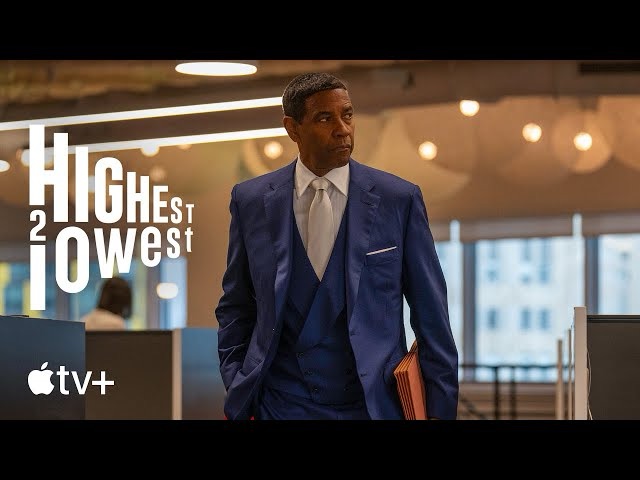
Clearly, The New York tourism board should just fund every Spike Lee movie.
Lee’s Big Apple is a beautiful, impossible, fantasy. The city is his greatest love and I’m sorry to anyone else in his life but it ain’t even close.
Highest 2 Lowest is a remake of Akira Kurasawa’s High and Low. That flick was based on the book King’s Ransom by Evans Hunter under the pen name Ed McBain.
Given all these influences you might think that the movie would take on the flavor of someone or something else like spoiled milk too long in a refrigerator. But, this is a Spike Lee Joint and it is unmistakably a Spike Lee joint.
So yes, there will be talk of Black excellence and opinions on the world at the current moment. This isn’t Lee from Bamboozled or Jungle Fever as he is mostly in the mood to entertain you. The only people he knocks around are fans of the Boston sports teams.
And how great is it that Lee takes a bit of time, and some of Apple’s money, to kick fans of the Red Sox and Celtics in the face?
I hate the Yankees! The only good days in baseball are when the Yankees lose. The only good years are when they don’t win the series. May they never have good things. And I still loved this.
So while Spike’s enemies are not my enemies I appreciate his level of disrespect. Let your sports hate fuel you man.
I don’t know yet where I rank this in the Spike Lee filmography. The man made films that are actually life changing, and turned an entire culture in his direction a couple of times. This is not Malcolm X or Do The Right Thing. But it’s up there with Inside Man as a thrilling film that mostly wants to entertain you.
There are some folks here who can’t act or maybe just shouldn’t share the screen with Denzel Washington but they are mostly minor players. I didn’t let it get me down. There are actors who have been doing this thing for decades and couldn’t share the screen with Washington. There’s only a few people in the world who can get near him. And most of them have Oscars and usually star in films written specifically for them.
A$AP Rocky delivers the goods and is a worthy foe for Washington. Their scenes together are electric. The old lion can roar, we knew that, but the young lion prowled the stage with confidence and charm.
The money drop sequence, which gives us the cops, the crooks, enthusiastic New York sports fans, a Puerto Rico Day festival, a complicated plan involving the subway, and a collection of mopeds is a high point not just in this movie but in all of Lee’s amazing filmography.
You can almost hear him cackling in the background and saying, “Y’all wrote me off? Well here I am mother (expletive deleted).”
There is a conversation out here amongst the knuckleheads I see online that the first hour of this movie is not good.
It seems clear that one of the points Lee makes in the story is absolutely correct: TikTok, cell phones and AI is destroying a generation . It’s annihilating your brains.
Summaries are not stories. Plot points are not stories. Aura moments are not stories.
Stories take time. Lee uses his time to introduce the players, explain how the kidnapping mix-up will happen and reinforce how the unique characteristics of Washington’s character (the best ears in the music business) and Jeffery Wright’s character’s connections to an unseen criminal underworld will help them in the climax.
The green headband switch is something that used to happen in the movies all the time but almost never does anymore because no one wants to risk the TikTok audience tuning out and turning on their phones. If you were looking at your second screen while it was happening you missed it.
If something like that is explained at all in other movies it’s done in dialogue. Lee does it properly and gives you everything you need.
Also, in the first hour of this movie you get to see Washington, the greatest actor of his generation, play a wealthy man facing an internal conflict.
Let me just say, Washington with a meaty role talking his way through a decent conflict is more thrilling than any train fights or shoot outs.
Those moments are why we have movies. Anyone can do the money drop sequence (though hardly anyone can touch Spike Lee’s version of it) but Washington is one of one. Anytime we get him doing something like this it’s a joy and a treasure.
Do I praise Lee and Washington too much? Yeah, well, I think you praise them too little.

 Dark Highways