Category: Uncategorized

  • Elvis

    Elvis

    This movie has the wrong title. 

    This isn’t ELVIS but instead, Col. Tom Parker Presents: Elvis. 

    The flick opens with 10 minutes of what I can only describe as Director Baz Lurhmann doing a Luhrmann.

    Crazy moving cameras, twisty shots, breaking up the screen into multiple images to give you a sense of several things happening at the same time. If you are familiar with Lurhmann you know what this is like. 

    I think it worked in Moulin Rouge. 

    But I almost didn’t make it to the other side this in Elvis. The crazy camera moves nearly gave me motion sickness. 

    Thankfully the whole thing calms down and Lurhmann seems content to mostly tell you a straitforward story about Elvis Presley. 

    But here we have our second problem. This straightforward story is told from the perspective of Parker, Elvis’ manager who exploited him, stole from him and possibly caused his death by hooking him up with a quack doctor who gave him the pills that led to his death at 44. 

    Of all the characters to tell this story he’s not the one I want to hear from. And then Tom Hanks decided to do the whole thing in a weird accent that I presume is meant to be Dutch but is a cross between a fantasy Italian immigrant and Jar Jar Binks. 

    “He’s got ta doa the songa about Santi Claas,” is a line a co-worker keeps saying to me. 

    Anyway, in real life, Parker apparently spoke with a southern accent. All I can think is that Hanks still has scars from playing Foghorn Leghorn in one of the worst Coen Brothers movies and didn’t want to do that again. 

    Since this is a movie and not a documentary I don’t know why Hanks just didn’t do it in his normal voice. Maybe he thought no one would believe the villain was a villain if he sounded like normal Hanks? 

    Aside from villain voice, I have only a few other small complaints. Please join me while I list them in no particular order. 

    Luhrmann depicts the musical influences that created Elvis by having him literally running from a juke joint to a church revival as a child. And I know it’s movie symbolism but it just made me throw up my hands and yell, “nonsense” to the heavens. 

    Another moment is when Elvis has a creative meeting about leaving Hollywood and refocusing on his music career under the decaying Hollywood sign. 

    “See, he’s leaving Hollywood! Get it!” 

    Ugh. 

    Finally, I know Elvis wasn’t a songwriter but the movie skips all of those scenes where the young artist perfects their music, writes their songs, gets ready for the big fight, etc. 

    Instead of Ray Charles writing a tune or Johnny Cash baring his soul in the studio we get Elvis on stage being told the girls are losing it because he is shaking his hips. 

    That’s a big part of the story. I can’t deny it. His motion below the ocean was scandalous at the time and a white guy doing “black music” in the way Elvis did it scared every racist adult in the country.

    But, I dunno man, he was also one of the greatest singers and bandleaders of all time. Was there nothing there we could also showcase? 

    There’s one small moment where he and the band are preparing for the Vegas shows and it hits some familiar sounds and that gave me chills. 

    But the tragedy of this movie is that may be the only moment like that in a two-and-a-half-hour flick. Instead, there is a ton of focus on Tom Parker.

    Elvis affectionately calls him the Snowman because he is the master of The Snow Job. Which the movie explains is when a carnival barker makes a bunch of money and the audience leaves happy even if they were kinda, sorta, conned. 

    And yeah, Elvis had more than a few snow jobs in his career. The movie claims that Parker sold both “I love Elvis” and “I hate Elvis” buttons. And it shows a ton of Elvis merchandise that Parker apparently got going. 

    At times the movie and Elvis praise Parker for his deal-making skills. Elvis clearly never lacked for anything even if Parker was taking half of the proceeds most of the time. 

    And the movie shows that Elvis, for whatever reason, couldn’t break away from Parker and be adult enough to take control of his finances and his health. 

    Elvis fans like to blame Parker for some of the bad creative and life choices Elvis made.

    This movie suggests that Elvis would have spoken up against segregation and institutional racism if Parker had not been around. Elvis wanted to be James Dean but Parker put him in the silly sing-along flicks. 

    And it seems his greatest sin, according to Luhrmann, was keeping Elvis out of A Star is Born. I have to agree that might have been great. It also might have been a bomb with Elvis instead of Kris Kristofferson. Nobody knows anything. 

    One of the biggest conflicts is Elvis’ desire to go on an international tour. But Parker blocks it with a Vegas residency that lasts years. The movie tells us that Parker can’t get a passport and that’s why he shuts the tour down. 

    But all I could think was, “This is a grown man with a family who can’t tell his manager he’s going to do what he wants?” 

    It might be true but it isn’t where I wanted to spend my time. 

    Anyway, Austin Butler is amazing as The King. Despite all my gripes, the movie races along with a decent and fun bio-story and the songs are all classics. 

    This movie isn’t a snow job but it should have been a masterpiece. Sadly, this is a long residency in Vegas instead of an International Tour.

  • Nightmare Alley

    Nightmare Alley

    Consider the doomed man. The man who is fated for tragedy. The man who is the protagonist, though not a hero – never a hero – of the noir story. 

    Director Guillermo del Toro knows just such a man. Having found him in a book by William Lindsay Gresham. The great director also has a personal connection to this man, who becomes, eventually, a medium who preys upon the grief of the wealthy. 

    Del Toro apparently had an encounter with mediums when his father was kidnapped. The director kicked two of them out of his mother’s house. But he had a first-hand look at the pain those who prey on love and grief can create. 

    In a way, this movie is about a director taking vengeance on a certain type of person. It reminded me of how Fargo was created in part because the Coen Brothers didn’t like a used car salesmen. 

    Nightmare Alley also has a murderer’s row of great actors. Bradley Cooper is the lead. Cate Blanchett is the femme fatale. Willam Dafoe plays the wily ringmaster, and Richard Jenkins is a powerful madman. Rooney Mara is the ingenue and David Strathairn is the washed-up keeper of a deeper magic. 

    I really could spend a lot of this review talking about how great this cast is but for the record Strathairn really stands out and Mary Steenburgen moves mountains with just a few looks in a bit part. 

    It’s visually stunning but it’s visually stunning in a way that suggests what you are watching doesn’t take place in what you or I would recognize as objective reality. We are in the land of fable and myth and film noir. It’s a little too perfect and at times it’s like it crosses the uncanny valley for me. 

    Sometimes they attacked the Coen Brothers too because their films could recreate the exact look of the genre they were working in. 

    I can see how some might view that as a great musician playing someone else’s hits. But if the music moves you then where is the harm? 

    The look of Nightmare Alley is perfect so if it was a bit too perfect at times it’s still mostly perfect. 

    Another thought about the works of another great director as it relates to Nightmare Alley. Quentin Tarantino has two movie universes. One that takes place in ‘the real world’ and the other that takes place in movie fantasy land. For instance, Kill Bill is the movie that the characters in Pulp Fiction watch when they go the movies. 

    We aren’t meant, I think, to mistake any of this for the real world. And when you watch it in that way it works on its own terms and in its own way. 

    I do have a few bones I must chew on. A line late in the movie about sex as the main couple falls apart rings hollow. 

    There were few, if any surprises, a scene early in the movie tells you everything you need to know about how the movie will end. 

    On the one hand, that’s fantastic storytelling but on the other hand, maybe I didn’t need my hand held this much. 

    Cooper is great but the movie never bothers to answer why we should care about him or explain how a woman could ever believe she should marry him. I suppose that it helps that he’s one of the most handsome men in the world. 

    I did enjoy that every step along the way characters keep telling Stan that if he follows a dark path it will lead to a dark end. Perhaps I would have cared more if he had at least tried to avoid his fate at some point. Perhaps I would have felt some sympathy for him when he eventually reached the long, dark night. 

    But it plays out like fate and if Stan ever stopped to question his role in the destruction of his own life it’s not on screen. 

    It was something that bugged me when my head hit the pillow an hour or two after watching Nightmare Alley. I always find it a good sign when a movie is still running through the corners of my mind hours, days or weeks later. It could be a bad thing if it leaves you with questions that should have been answered that remain unknown. 

    But as I drifted off I felt like I got it. What bothered me was that Stanton Carlisle gets what he wants or what he says he wants out of life midway through the movie. He has a woman who loves him. He has a successful career that he has built. He has money, if not wealth, he’s clearly doing better than most of his contemporaries. 

    Why then does he risk his whole life doing something that multiple characters have warned him will lead to destruction? 

    It’s a question that has been on my mind a lot these days as I watch some people basically self-immolate for what seems to me to be no reason.

    Here’s the answer I think the movie gives. This story takes place after Stanton Carlisle committed a great crime. The crime is suggested early and then presented in its entirety near the end. 

    And so when I thought about what Stanton wanted I thought about this crime and it hit me. 

    What Stanton Carlisle wants most in the world is to be punished. 

    And in film noir one truth is absolute: Evil men must pay for their sins. 

    The final shot of the film is a close-up of Stanton Carlisle as the door closes on his life. A wave of powerful emotion rolls over him and Bradley Cooper is magnificent at making you live in this moment with him. And I can’t tell you what to see in his face. 

    But I can tell you what I saw the moment judgment was handed down.

    It looked like relief.

  • Ambulance

    Ambulance

    The most fun I’ve ever had watching a Michael Bay movie was when I turned on the infamous commentary track from Ben Affleck for Armageddon.

    If you have never heard it I urge you to track it down. Affleck spends the entire running time making fun of the premise of the movie and his own performance.

    I asked Michael why it was easier to train oil drillers to become astronauts than it was to train astronauts to become oil drillers, and he told me to shut the f**k up.

    Ben Affleck

    The second most fun I have ever had at a Michael Bay movie was when I was in high school and saw The Rock for the first time. The Rock was about as good as American action cinema got in the 1990s. You’ve got Nic Cage just starting to ascend as a movie hero, Sean Connery playing Bond (it’s not Bond for legal reasons but it’s Bond), and Ed Harris as a complex and interesting villain.

    That’s gonna put Ambulance at number three, maybe. The Transformers movies aren’t for me and I remember liking Bad Boys but not enough that I ever want to watch it again.

    I didn’t have a lot of hopes for Ambulance. I grew up and Michael Bay never did. My plan for Bay over the last 20 years or so was just to avoid him. He is a great action director but he is not interested in the things that I am interested in and his movies do not seem like they are ever going to be about the things that will entertain me.

    You should not go into a restaurant in a desert and order seafood. Nor should you ask Michael Bay to suddenly wake up one day and become Tarantino, or Fincher, or Nolan.

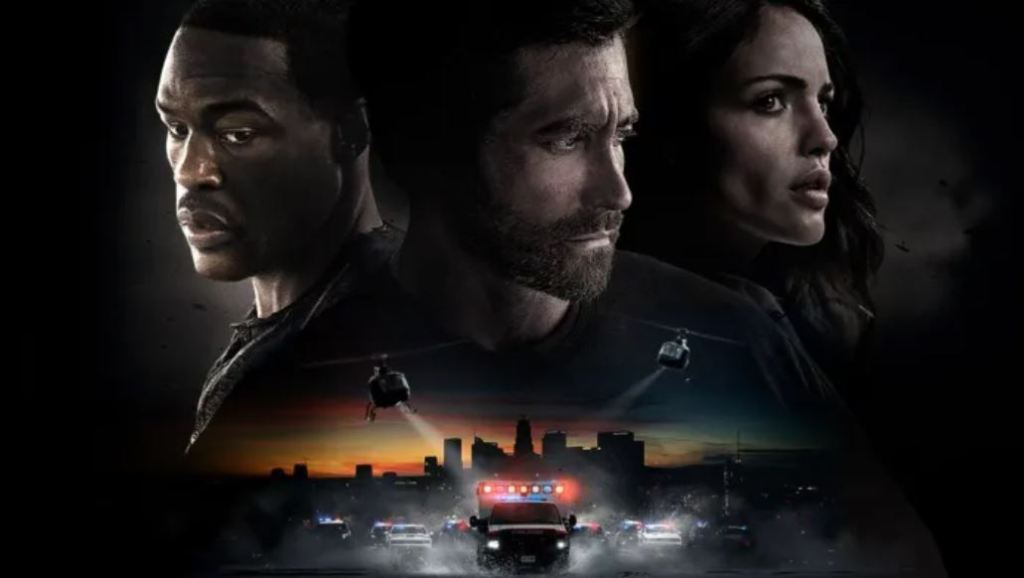
    But, after I got past a weak set up this turned into a good time. Ambulance is two things: Its Heat but only the cool bank robbery and chase scenes and it’s Grand Theft Auto: The Movie.

    Danny Sharp (Jake Gyllenhaal) is a coked-out criminal genius who has a major bank score planned and primed. His brother Will Sharp (Yahya Abdul-Mateen II) is a soldier who got out of the crime business but needs a big score to pay for his wife’s surgery. It might have been his daughter’s surgery. I wasn’t paying that much attention.

    If you can get over the ridiculous setup of Will coincidentally arriving at his brother’s house on the very day of the heist. Or past the idea that someone like Will would go along with this at all, then the rest of the movie is a money machine.

    Gyllenhaal screaming “This is Cashmere!” after he gets blasted with a fire extinguisher? Money.

    Garret Dillahunt as a no-nonsense LAPD captain who calls off a chase because his beloved dog might be in one of the cars and in danger? Money.

    Eiza Gonzalez as the the most beautiful and competent paramedic in the world? Money.

    The two leads singing the 1979 Christopher Cross hit Sailing during the chase? Cash on the barrelhead!

    All of that plus repeated shoutouts to the best crime video game of our lifetime. That includes — at one point — avoiding the cops by having the ambulance quickly spray-painted under a bridge.

    Sometimes you go to a restaurant and take a chance on something different. Isn’t it nice when that works out and you leave the table full and satisfied?

  • The Banshees of Insherin

    The Banshees of Insherin

    In The Banshees of Insherin writer/director Martin McDonagh creates a devastating portrait of a civil war where nearly all the most vicious wounds are created when the characters are cruel to each other.

    The movie begins when Colm (Brendan Gleeson) tells Padriac (Colin Farrell) that he doesn’t want to be friends anymore. Padriac lives with his sister and is clearly a little slow. He has a friend named Dominic (Barry Keoghan) who is a little slower than he is. And his sister Siobhan (Kerry Condon) is a woman of grace and intelligence but is perhaps, too emotionally slow, to realize quickly enough how badly the war with Padriac and Colm will end.

    To our graves we’re taking this. To one of our graves, anyways.

    Pádraic Súilleabháin

    Colm and Padriac are drinking buddies on a little island on the coast of Ireland in 1923. Their country is in the midst of a civil war. They are so close they can hear the shooting sometimes and the explosions. But there is no battle scene in this movie, except for the battle going on in the hearts of the men at war with each other.

    Padriac is hurt by Colm but also selfish and unwilling to believe his longtime friend is really serious about his wish to end their relationship. That Colm is deadly serious — and the extremes to which he goes to make his point clear — drives the movie and its characters to their end.

    McDonagh began as a playwright and he builds a castle here, line by line, brick by brick, that he then pays off in the second half of the film. The whole enterprise becomes thrilling when all the choices and consequences and throwaway lines in the first half of the movie began firing at the viewer during the second half.

    Look at this I found. A stick with a hook. What would you use it for, I wonder. To hook things that are the length of a stick away?

    Dominic Kearney

    It’s like a boomerang, things went flying past the audience in the first part and then they come home, lit afire, and nail down the movie’s themes and motives.

    One of the wonders of Banshees is that while there is shocking violence in it it’s never as powerful as the language. There is a moment where one character tells another he will burn his house down. And that conversation, that turn, is harsher than what actually happens next.

    You used to be nice. Or did you never used to be? Oh, God. Maybe you never used to be.

    Pádraic Súilleabháin

    The movie doesn’t include a ton of subplots, nor does it need them, but a fumbling attempt at love by Dominic just absolutely broke my heart. Some of us get to have love and families and the lives we wanted or chose. But for many people, those things are just out of reach and usually through no fault of their own. They have their dreams and that’s all they will ever be, just dreams.

    All of this feels Shakespearean and there seems to be dark magic just at the edge of the characters’ lives. There is an old woman in this and she seems to just sort of appear out of the mist from time to time. She reminded me of one of the three weird sisters in the Scottish play.

    Pádraic hides from her behind the stone fences when he sees her coming. Two other characters call her a ghoul. At one point she announces that death is coming. Then she adds that it could be two deaths.

    Then later she leads a man to a body. Why she chose that man, to recover that body, is deeply telling.

    The Banshees of Insherin is dark, cruel, funny, and ice cold. I’m convinced it’s the best movie of 2022.

  • The Batman

    The Batman

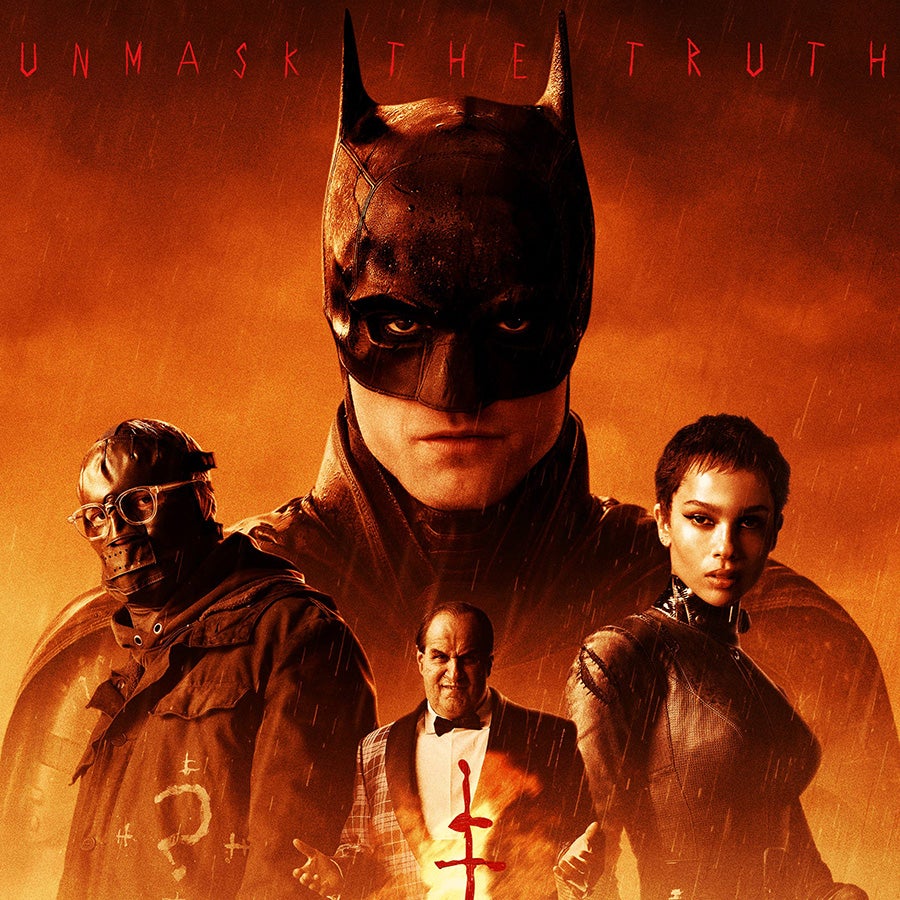
    And suddenly Batman becomes a Rorschach test for directors. 

    Where James Bond is almost always James Bond and Spider-Man remains Spider-Man we now live in a world where each new director is allowed to reinterpret and reintroduce Batman to the masses. 

    Director Matt Reeves gives us Batman Year Two. With a caped crusader who really is The World’s Greatest Detective and pretty handy in a brawl. 

    The previous bat outings over the last two decades each had their moments but I had serious issues along the way. Nolan’s Batman was ‘realistic’ in a way that eliminated a lot of the fun comic-book action from the movies. I thought it was good and I even give high marks to the third one (the one everyone else seemed to dismiss) but there was not nearly enough Batman in any of those movies. 

    Snyder’s Batman was just The Punisher in a bat suit and extended his streak of seriously misunderstanding nearly every comic book character he ever touched. 

    Reeves Batman is Batman, he has a code against killing and guns. He puts fear in the hearts of criminals. He risks his life to save others. 

    But I have qualms here too.

    Reeves and Robert Pattinson envision a Bruce Wayne that is a reclusive mopey Kurt Cobainesque rockstar. That is certainly one way to go. And it’s not a take I have ever seen before. 

    But Bruce Wayne is barely in it. Alfred gets sidelined too. 

    But Paul Dano is puzzle perfect as The Riddler. John Turturro is a solid mob boss. And Colin Farrell’s Penguin is money all day. 

    Zoe Kravitz and Jeffery Wright do what they can as Batman’s sidekicks. 

    However, this thing is just too long. As the mechanics of the plot and the relationships get drilled out I just kept grabbing my hand rests and praying for another bit of Bat action. 

    Every time we got one they were amazing. The battles in a train station and a stadium stood out and a batmobile chase was one of the best things I saw at the movies last year. 

    Can we add a Robin next time? The Dark Knight needs some color and to, ever so slightly, crack a smile.

  • Cinema Speculation and Rolling Thunder

    Cinema Speculation and Rolling Thunder

    I’m reading Tarantino’s Cinema Speculation and for those of you who love Tarantino, this is a fascinating look at the movies he grew up with. 

    Not exactly an autobiography as much as an autofilmography of the flicks that shaped him. Most of them I’ve seen or have no interest in. 

    And then we got here, to something called Rolling Thunder. Originally written by Paul Schrader (Taxi Driver) but reworked by screenwriter Heywood Gould, Star William Devane, and director John Flynn. 

    Schrader hated the new direction but those of you who love revenge flicks are gonna have a blast.

    I decided I needed to see it before I read the chapter about it. And mannnnnn, this is it. 

    It’s seedy cheap 70s cinema at its finest. The first half is a character study of a POW returning home from Vietnam and completely works as that sort of movie. 

    And then we get an exceptional and exceptionally violent revenge picture. Young Tommy Lee Jones and Ed Devane look like gangsters in their sunglasses and dress uniforms. And you just know they are gonna burn something down when the time is right. 

    You will also probably, like me, cackle at how many things Tarantino has homaged out of this flick. I recognized every seedy bar in every Tarantino movie as coming directly out of this slice of the 70s. 

    Anyway, the book is great. The movie is hot fire.

    Tarantino says he’s going to make one more film and then get out of directing movies. The book mentions several directors who Tarantino believes should have quit when they were on top.

    If he does I hope we get more books like Cinema Speculation although, this time, I’m hoping he goes behind the behind-the-scenes of his own work.

    Screenwriter William Goldman’s Adventures in the Screen Trade and the sequel, Which Lie Did I Tell, More Adventures in the Screen Trade looms large in the area. Goldman’s first book was such a scandal that he was excommunicated (for a while) after it came out.

    Cinema Speculation is a nice warm-up and Tarantino doesn’t have any qualms about talking frankly about the stars, directors, and writers who made the movies he loved. He even takes Martin Scorcese to task for the interviews he did after Taxi Driver where the director claimed the rampage ending was not supposed to get audiences cheering.

    Tarantino calls bullshit on that.

    He also has apparently waited in the tall grass for 30 years to take down one particular critic of his work. Nobody can hold a grudge like an artist.

    However, I’d like Tarantino to tell us about his own work and the behind-the-scenes fights to get it on the screen. Those tantalizing details are just out of reach in this book.

    Tarantino probably has the stories to match Goldman and the guts to tell it all.

  • Everything, Everywhere, All At Once

    Everything, Everywhere, All At Once

    ‘If only,’ can hit you harder than a bullet.

    If only you had taken that job. If only you had gone to that school. If only you had asked them out. If only you had not taken that drink.

    Everything, Everywhere, All At Once is a sci-fi flick that uses the multiverse theory — that every decision we make leads to a new universe — as the backdrop for hi-jinks, comedy, and kung-fu action.

    But the heart of it is “if only.”

    Evelyn Wang (Michelle Yeoh) thinks her life would be better if only she had listened to her father and not married her husband, Waymond.

    Perhaps her days wouldn’t revolve around their middle-class laundry business and her taxes. Perhaps her relationship with her daughter, Joy (Stephanie Hsu), would be better. Perhaps she would have found success in one of her many hobbies.

    Instead, she’s in a marriage that’s teetering on the brink, she has a daughter she fails to appreciate, a father who is back in her life after decades of silence, and an IRS auditor (Jamie Lee Curtis) who seems to take sadistic pleasure in reaming people financially.

    The joy of this movie is that the multiverse plot allows it to be a ton of different movies simultaneously. It’s well named because it is, indeed, everything, everywhere all at once.

    For sci-fi reasons Evelyn — who we learn is the worst version of herself — has to connect with her multiverse counterparts. In one, she never marries and is a successful kung-fu action star, in another she’s a successful singer, there is one where humanity branched off in a strange way, and in another, she is a cook.

    Yeoh, Curtis and Ke Huy Quan get to have a lot of actor fun playing different versions of their characters. But Hsu is a real breakout, getting to change personalities with just a look and stealing a lot of the movie as a tragic figure who is fighting with her parents in every reality.

    The movie’s premise also allows it to insert several different movies, for a scene or two, inside the main narrative. So our characters get to play a high-class, fashion-conscious romance for a few scenes and then to do a wacky comedy moments later.

    I think what is most impressive is that nearly every little scene and mini-movie is excellent in its own right. A flick like this should have tone problems or be in danger of flying off the rails. But it never does.

    Everything feels right and everywhere the movie goes no matter how wild or wacky feels like home.

    It’s one of the best movies I’ve seen this year.

  • Avatar: The Way of Water

    Avatar: The Way of Water

    James Cameron went away for more than a decade to turn his U.S. Military versus eco-warrior aliens movie into a five-picture franchise.

    If I thought about this at all, it was only on a family vacation to Disney World and a visit to Avatar land inside Animal Kingdom. I did sometimes wonder why the guy who proved himself to be one of the most successful filmmakers of all time chose to dedicate decades to this particular story.

    As the film grew closer my Movie Friend (MF) kept telling me this was going to be one of the best movies of the year.

    I remained unconvinced and unmoved.

    “He’s cooking,” MF said.

    MF says a lot of things. He falls in and out of love with a lot of movies. He saw about 120 new releases this year and he calls it a slow year.

    But, one thing MF has is decent instincts and good taste. So even though I wasn’t planning on seeing Avatar 2 in the theater I broke down and went to an IMAX 3D showing with MF by my side.

    About 15 minutes into it, after the first battle and when Jake Sulley is trying to find a way to discipline his kids but sounds too much like a battle commander and not enough like a father I leaned over to MF and conceded.

    “Dang it, you were right,” I said.

    If we had bet on it I would have owed him money.

    Avatar is not Star Wars because few things in life can be among the very best that cinema and sci-fi have to offer. But Avatar: The Way of Water is close to Empire Strikes Back. It’s a movie that is so good that it retroactively improves on its predecessor and shows that Cameron’s bet on the Na’vi makes a lot of sense.

    Having done the hard work of setting up the science fiction world, the stakes and most of the major players in the first one, Cameron is free to spend three hours telling a story without a ton of exposition. The movie no longer needs to explain the Na’vi just as a new Star Wars thing no longer needs to explain a Jedi.

    As the movie opens the aliens of Pandora have lived in harmony for about 20 years without those pesky humans and Jake Sulley and his wife Neytiri have two sons, a daughter, an adopted daughter, and a human child that was left behind that they have also adopted.

    But the humans (sky-people among Pandora) return and the forest Na’vi are once again immediately outgunned and outmanned.

    Cameron and his team give everyone in this large cast reasonable issues, personalities, and motivations. He also brings back his Marine villain from the first movie in a unique way and gives the characters an excuse to discover a new portion of Pandora with a tribe that has a connection to the ocean in the same way the first movie was set in a forest.

    The running time was a very serious discussion before the flick was released but any experienced moviegoer knows that a bad movie is always too long and the running time on a great movie will be of no consequence. Avatar: The Way of Water finds the right balance between family drama and action, it never drags and it wraps up all of its storylines in mostly satisfying ways.

    It’s very much the second part of a multipart story though. In the same way that Empire ended on a cliffhanger, The Way of Water doesn’t so much end as come to a comfortable stopping point in the story.

    Once again, Avatar’s evil marine commander gets all the best lines.

    A marine can’t be defeated. You can kill us, but well just regroup in hell.

    Miles Quaritch

    But dialogue has never been Cameron’s strong suit and just like in the first movie what’s important to Cameron and his team is the visuals, the unique aliens, and the broad nature lovers vs. machines story.

    This is one of the best movies of the year and it justifies the time, hassle, and expense of seeing a movie in a theater. If you haven’t caught it yet and you enjoy sci-fi spectacle on a big screen then I can’t recommend it enough.

    At one point in the flick, one of the characters hangs out with the Na’vi version of a sentient whale. They have become friends and under a glorious sun, they float in the water together in what most cinema lovers would call a perfect shot.

    At that point, MF leaned over to me and smiled.

    “Movies man,” he said.

  • Apocalypse Na’vi

    Apocalypse Na’vi

    With James Cameron’s Avatar 2: The Way of Water waiting in the wings I decided to watch the first Avatar again. 

    I saw it for the first time in 2009, in IMAX 3D (did we have IMAX 3D back then? I saw it in 3D for sure.) on opening weekend. I enjoyed it then, for what it was, and then I never watched it again. 

    But for 13 years, we have all lived in a world where Cameron was working in secret, if not silence, to make four sequels to Avatar. Avatar land opened at Animal Kingdon in Disney World in less time than it has taken to make the first sequel. 

    And the question — for me at least — is what did Cameron see in this story he was telling, that enraptured him so much, that he’s going to spend a good part of his working life putting together a franchise? 

    Avatar is a broad and familiar story set in a science fiction universe. Jake Sully, a space marine, is in a wheelchair after being injured in an unseen conflict. He travels to Pandora and is given the ability to get into a virtual reality pod and mind-meld with a cloned suit that will make him one of the Na’vi. The Na’Vi are tall, blue, catlike creatures who can connect with animals on their homeworld via a genetic mutation in their tails. 

    Sully is supposed to work with a group of scientists to connect with the Na’vi and convince them to move away from their sacred tree so that the Space Marines and an evil corporation can mine for (I kid you not) unobtanium. 

    All of this plays out and looks like the opening of a video game. If you’ve played say Halo, and gone through the opening encounters where the game teaches you how the controllers work, then you have watched the opening of Avatar. 

    The rest of the movie hits every story beat exactly as you expect. Will Jake Sully fall in love with a Na’vi woman? Will this woman be the daughter of the chief? Will he betray the evil corporation and lead the Na’vi into battle against the bad humans? Will everything mostly work out in the end?

    I’m beating up on it more than I should. 

    It’s visually stunning. Everything Stephen Lang — as the evil head of the evil space marines — does proves he’s an incredible badass villain. He also gets all the best lines in both movies. 

    “If there is a Hell, you might wanna go there for some R & R after a tour on Pandora. Out there beyond that fence every living thing that crawls, flies, or squats in the mud wants to kill you and eat your eyes for jujubes.”

    Col. Quaritch

    And a story like this demands that it be broad and simple and be understood in multiple languages for those sweet foreign markets. 

    I never doubted how the first Avatar was going to end. Just as I never doubted that Thanos would ultimately be defeated in Endgame. 

    What I did doubt was that Cameron could take what he gave us in Avatar and then make a compelling sequel. And, having seen that sequel, wooo boy was I wrong.    

  • War Horse

    War Horse

    A master can take anything and make a masterpiece. 

    Picasso and his canvas, Willie Nelson in a studio or on a stage, Mamet preparing a play or Stephen King with a new story in mind. 

    Or Steven Spielberg making a movie. 

    After The Fabelman’s came out I looked through the Spielberg catalogue and wondered what I had missed. Most of what he’s done, good, bad or indifferent, I saw when it came out or shortly after.

    And some of it I wasn’t alive for but I’m mostly caught up.

    But War Horse looked hoky and so I let it pass by. I caught it this weekend as I moved through the list. 

    The first thing that struck me as it the end credits rolled was how much of this movie felt like classic Hollywood. That’s usually Speilberg’s thing but this was especially old school.

    I’m not sure any other filmmaker has the taste or the options that are available to Spielberg. At this stage of his career he can do pretty much whatever he wants. And it seems like what he wants to is to shoot for classics. 

    If you had told me War Horse was a lost movie from the 1950s the only thing that might have give me pause would be the digital color palette. 

    Spielberg, or at least the Spielberg of the last 20 years or so, tends to make movies that live in the legacy of the classic, classy filmmakers of his youth. 

    After War Horse he made Lincoln, Bridge of Spies, The BFG, The Post, Ready Player One, and a remake of West Side Story.

    I think Lincoln is one of the great movies in American Cinema and I think the rest are all good to great. (I’ve not seen the BFG or Ready Player One). 

    But I also think that Spielberg has clearly made a choice to make movies for everyone. 

    This is maybe the only war movie made in the last 40 years in which there is absolutely no blood. 

    That doesn’t mean it’s not good. They made classics for decades under the Hays Code. 

    But even as the director and the camera found another unique way to hide the violence I couldn’t help but be struck by just how good Spielberg is at this. 

    There is a shot where he uses a windmill to shield us from a shooting. And another where the audience learns the fate of a group of rides just by seeing the horses ride past a group a machine guns. The horse run free, their riders dead in the field behind them. 

    War Horse is, essentially, a series of vignettes about the war. We see life in the shire (kidding — it’s a farming community in England) before the war. 

    Then the movie moves through the lives of England’s mounted cavalry, German soldiers, a French farm and finally into the the horrors of trench warfare. 

    At several points I was amused by what can be done when you have, essentially, unlimited funds and massive manpower. 

    You can, essentially, send an army into No Man’s Land and have everything look absolutely realistic. 

    I don’t want you to think that I was wrong when I assumed this was a hoky movie 11 years ago and ignored it. 

    It is a hoky movie. And a hoky horse movie at that. 

    But Spielberg is still a master and watching this — seeing the warm heart and directors expertise at work — I couldn’t help but be swept along. 

    With fifty years of filmmaking behind him War Horse may not even make it into Spielberg’s top 10. 

    But it’s a fine work done by a master. It’s got his signature on it from the opening shot till the curtains come down.