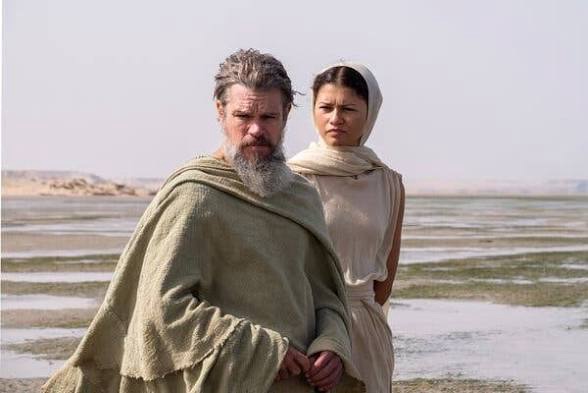
Aye gods what a flick.
So much to unpack here and despite the jokes about spoilers for a several thousand year old story — that most of us were taught in school — there will in fact be spoilers in this review.
First, I joked with a friend before seeing this movie that if Sir Christopher Nolan told this tale with a timeline that went from the middle out I was going to scream so loud the sirens would cover their ears.
Well, Nolan gonna Nolan.
Still, the master has mixed the spectacle and storytelling chops of Steven Spielberg with the frenetic pace of Martin Scorsese.
So, while it’s epic in scope, no one scene or shot or moment is epic in length. This gives Nolan the freedom to make it through a saga in 2 and a half hours. However, like Oppenheimer, once the show starts it ramps up to a frenetic pace and never slows down.
To be fair and to do Nolan’s particular skills justice this is not a timeline experiment or a puzzle like several of his other works. Instead, it is a tale told by several storytellers who are weaving in and out of various parts of the yarn.
Nolan doesn’t really depict the gods here, you will get no Olympus and the one god who moves through the story is a manifestation of Odysseus’ guilt and not truly noble Athena.
This narrative gives Nolan a bit of a cheat as nearly every fantastic thing that happens is not presented as fact but rather as the memories of a veteran suffering from enormous guilt and post traumatic stress disorder.
So you can see the magic and monsters as true or you can see them as the symbols of tragedy, loss, and despair of a man who sacrificed most of his life to war.
This idea is not new to me but it is correct that Nolan’s Odyssey is somehow a thematic sequel to Oppenheimer. Both are about men who believed they were doing what they must do to defeat implacable enemies only to find that their ingenious solutions destroyed themselves and their civilizations.
Nolan, being Nolan, somehow gives even this tale a central mystery that deepens the narrative and provides structure to the whole enterprise.
Why does brave and cunning, Odysseus choose not to return home? What truly keeps him from his wife and son?
Ages ago, when I was in high school, Mr. Cramer told us of the Greek Myths and explained Joseph Campbell’s The Hero with a Thousand Faces.
Almost every hero will have a mysterious birth, be trained by a mentor, overcome challenges that most men cannot and then die and be reborn.
These similarities connect all of our great myths from Odysseus to Hercules, to King Arthur and on to Luke Skywalker.
Arrogant Odysseus loses his entire crew and his ship and goes into the water to his death, Mr. Cramer said. When he comes out of the water he is finally humbled and now reborn and can return home.
Nolan depicts this slice of the movie as a man who must finally give up control and give himself over to the will of the gods.
Which is interesting coming from a guy who turned a whole industry around by resurrecting film, and then branding it in such a way that almost guarantees whatever he makes will be a blockbuster. And, and, and, he is almost alone in shooting movies in a practical way that is exorbitantly costly but somehow incredibly lucrative.
So when exactly does Sir Christopher Nolan give up control?
Perhaps when you let go of the film and give it to theaters?
On this it seems that Nolan should have no fears. Screenings of The Odyssey sold out a year in advance. People are literally delaying pregnancies in order to make sure they can travel and see this thing in 70 mm.
Of course, I do wonder if that tale is true or if it’s just a myth invented by a canny filmmaker who has mastered both the art and the commerce of Hollywood.
Let’s wrap this up Nolan style with some breakneck final thoughts.
- Odysseus and his crew spend so much time running away from danger and back to their ships that I thought Matt Damon should have been replaced with the king of running in movies: Tom Cruise.
- They flee so much that someone should have hired John Cleese to shout, “Run Away!”
- The cast is stacked and Nolan makes excellent use of everyone. Except maybe Zendaya. Anne Hathaway steals the thing from all the boys though.
- This is more a horror movie than an action tale. Was not quite prepared for that.
- Nolan gives you the cyclops, Circe and her magic, Scylla, Charybdis, the sirens, Penelope’s loom, Agemmenon’s fate, Hades, Calypso’s island vacation, the sack of Troy and the most violent homecoming in myth. All this, and he still leaves enough room for you to treat Troy as a prequel.
- Seen in IMAX 70 mm at Indiana State Museum about an hour away from home with a sold out crowd. Had to watch it at 9:30 pm to get a seat. Took a vacation day the next day. Worth it.
What a picture!


Leave a Reply